
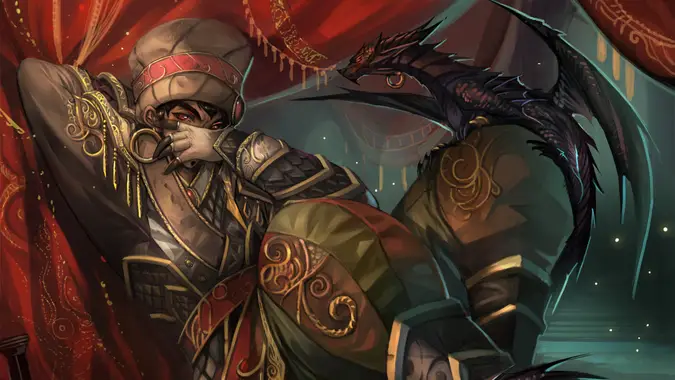
The first time I encountered Wrathion in Mists of Pandaria, I was suspicious of him in the way you are suspicious of someone who is performing transparency. He tells you who he is. He explains his motives. He places himself above the factions with a reasonableness that is almost disarming: I don’t care who wins this war. I care who survives what’s coming. The intelligence is genuine. The long view is genuine. The care — and he does care, in his way, about Azeroth, about the pieces he’s moving — is sometimes genuine.
That is precisely what makes him so difficult to comprehend and identify.
It took me longer than it should have to recognize the pattern in a colleague, inhabiting this world of institutional life beyond Azeroth. Not because the pattern was subtle, but because she is genuinely intelligent, genuinely progressive in her stated commitments, and genuinely sometimes useful to me and to people I care about. These are not fictions. They complicate things in ways that are inconvenient if you want a clean villain. And the desire for a clean villain, I’ve learned, is its own kind of trap. And the people who operate through sophisticated extraction rarely give you one.
What Wrathion taught me — what the encounter with the person in my institutional life eventually confirmed — is that complexity can be a mechanism. Not cover, simply. Not performance, entirely. The complexity is real, and it is also doing a lot of active work.

The Tavern of the Mists
Wrathion holds court in the Tavern of the Mists, a space that is aesthetically, geographically, and politically above the Horde-Alliance conflict. He is attended by Fahrad, his loyal Blacktalon agent, who keeps the ambient temperature comfortable and who would be genuinely confused if you suggested his service had political consequences. The tavern is neutral ground. The dragon presents as neutral. This is the first move: the claiming of altitude.
What altitude does is create the conditions for field management. When you are above faction, you cannot be accused of faction loyalty. You are simply seeing clearly what others, mired in their petty conflicts, cannot. You are managing relationships across lines for the greater good. When you speak to the Horde champion and the Alliance champion in the same week, offering commissions and perspective, that is not duplicity. That is wisdom. That is the long game.
But here is what altitude actually produces: a board. And a board requires pawns. Pieces to be moved about for strategic advantages.
Of course, the pieces do not always know they are pieces. That is the elegance of the arrangement. You are not recruited to the board. You simply find yourself on it. One day, mid-conversation. Realizing that you have been a position, a move, a contingency. That your standing on this board was never yours to establish. It was extended to you while it was useful, and quietly repositioned, even removed or sacrificed, when it became inconvenient.
I had recently come to realize I had been a piece on this person’s board. I know this not because she told me, but because I watched how she moved me.

What Gets Circulated
Institutions run on information, but they are really run by the circulation of assessments. Not data, impressions. That is carried by tone and emphasis. The subtext implied, not just the words spoken. The ambient judgment that precedes your name when it enters a room you’re not in. She’s ambitious. She’s a lot. She’s doing that PhD, you know. Each of these is technically accurate. Each has a particular valence when circulated by the right person at the right moment. The assessment is not a lie. It is position-taking. And who circulates it, and to whom, and with what tone, shapes what becomes true about you institutionally.
The person I know is skilled at this. She circulates with warmth. The assessments travel in the register of collegial concern, of nuanced observation, of the generous acknowledgment that someone is “complex” or “passionate” or “a lot.” The vocabulary is careful. The effect is not.
I became aware, gradually, that certain doors had closed. They weren’t slammed, just quietly come to be noiselessly latched. This closing happened in ways that corresponded to this person’s relational network. I became aware that my intellectual work, my doctoral studies, had been framed in some conversations as a form of striving that made people uncomfortable, rather than as the scholarly contribution it actually represents. I became aware that another colleague, one who fights harder, hides less, and makes more people uncomfortable for better reasons, had been repositioned even more aggressively. Her difficulty was made legible, her precision read as bald aggression, her willingness to name things received as the problem rather than the clarity it actually is.
You can call this gossip. But I think that word is too small. What I’m describing is reputation management in service of board stability. In a more negative register, it can be called character assassination. When a piece’s complexity threatens the ecosystem, the board manager repositions it. Maybe not maliciously. That’s the important part. It’s generally done with genuine concern. With the belief, possibly sincere, that the repositioning serves everyone.
Wrathion does not think of himself as harming Azeroth. He is saving it. The people he sidelines, maneuvers around, sacrifices for the long game — he probably regrets the consequences on some of them. He may have genuinely liked many of them. And yet, that doesn’t change what the move was.

The Structure of Sophisticated Extraction
Let me name the mechanism precisely, because describing it is the heart of this whole project.
Sophisticated extraction operates through the following moves, not always in this order, not always consciously:
First: the genuine complexity. The values are real. The intelligence is real. The progressive commitments, stated and sometimes even enacted, are real. This is not hypocrisy in the ordinary sense. It is something subtler. A person who believes in equity and also benefits from the arrangements that undermine it, who holds those two things without cognitive dissonance because the board management is not registered as contradiction. The complexity provides the cover because it is true, not a fake front. You cannot call it cynical because it isn’t fully cynical. This is what makes identifying it with precision very difficult.
Second: the altitude claim. I’m above the faction conflicts. I understand all sides. I keep things collegial. I’m the person who can work with everyone, who translates across camps, who holds the room together when it wants to fly apart. This is the neutrality performance. And again, it is not entirely performance. The person holding altitude often genuinely believes they occupy it. The problem is that altitude, in a political situation, is itself a position. There is no view from nowhere. Managing the temperature of the room is a choice about which fires to let burn, which to ignite, and which to smother.
Third: the board management. From altitude, you can see the pieces clearly. You can move them. You can position them in ways that serve the overall stability you are curating. It’s the stability that, not coincidentally, protects your own standing and relationships. Pieces that destabilize the board get repositioned. Pieces that are useful get access. Pieces that might expose the structure get quietly limited in their reach. None of this is violent. Oh, no, never that. It operates through the gentlest possible means: a word here, a framing there, an introduction withheld, an assessment circulated.
Fourth: the extraction. Here is the theoretical claim I want to stake: extraction, in this model, is not a byproduct of the other moves. It is what the other moves serve. The complexity, the altitude, the board management — all these are the conditions under which extraction becomes possible and remains invisible. What gets extracted is labor, loyalty, intellectual contribution, relational energy, and, most importantly, reputation. It flows from the pieces into the position of the board manager, who gains influence and institutional standing from the work of the network without being accountable to it.
This is why the title insists on sophistication. Extraction is not always this elegant. Sometimes it is crude, demands made without reciprocity, credit taken visibly, contributions appropriated without subtlety. Sophisticated extraction looks nothing like that. It looks like mentorship, collegiality, support, and access. You don’t notice the weight leaving you until you are lighter than you should be.

What Wrathion Gets Wrong About His Own Neutrality
There is a Wrathion moment in Mists of Pandaria that I return to often. He has been playing both sides of the Horde-Alliance war, offering commissions to champions of each faction, collecting data on the conflict. When confronted, he is not exactly defensive. He explains. Actually. He explains carefully, intelligently, with genuine conviction. He sees what others don’t. He is playing a longer game than faction loyalty allows. The war doesn’t matter. What’s coming matters.
The explanation is coherent. But here’s what’s necessary to remember. The explanation is also a deflection.
Because the question isn’t whether Wrathion’s analysis is correct. The significant question is what it costs the people he’s been using to enact his analysis. And that question doesn’t register in his framework, because the pieces on his board are instruments of the long game — necessary, occasionally valuable, ultimately subordinate to the vision.
What the person at my institution gets wrong about her own neutrality is structurally identical. The institutional relationships she maintains, the temperature she keeps stable, the “I understand where everyone is coming from” she deploys at critical moments — these genuinely serve the collegial environment she values. She believes in that environment. She is not wrong that collegiality matters. But the collegial environment she is curating is one in which certain moves never get made, certain patterns never get named and confronted, certain people never get the standing they’ve earned — because naming them, making them, acknowledging them would destabilize the board.
The stability is the product. And the stability protects this person’s position at least as much as it protects anyone else’s.
This is not villainy. It is Bourdieu’s habitus in action: the internalization of field conditions so complete that one’s own position-taking registers as disinterested service. The person is not lying when she says she wants what’s best. She just has a definition of “best” that she has never fully examined, because examining it would require sitting with what her board management has cost people she probably considers colleagues and sometimes friends.

The Discipline of Accurate Intelligence
I said at the beginning that Wrathion is someone you can’t dismiss entirely because he sometimes moves pieces in ways that benefit you. That remains true. He is a useful node in the network of Azeroth’s politics. You would not want to burn that relationship down entirely. There are things you need, occasionally, that only he can provide access to.
The same is true of the person at my institution. She has institutional reach. She has relationships I do not have. She has, on occasion, been genuinely useful. Helpful, even. None of that changes the structure of what I’ve described. It just means the discipline is specific.
The discipline is this: utility and loyalty are not the same thing. Access is not alliance. Being a useful piece on this person’s board does not make you a player on it in any position that protects your actual interests. The mistake — the one I made and the one I see made around me — is to read the warmth as the relationship when the warmth is the mechanism.
This is not cynicism. It is accurate intelligence about terrain. Wrathion can be a useful contact. He cannot be a confidant. He cannot be someone you show your full hand to. He cannot be the person you bring something to when it requires him to choose between your interests and his board stability. You must know and accept Wrathion will always choose the board. Not because he doesn’t like you, but because the board is what he is managing and you are just a piece on it.
The corollary is this: knowing the structure doesn’t require burning the relationship. It requires changing what you do with it. What you bring to the person at my institution, what you keep out of her reach, what you let her circulate versus what you protect. All of these are adjustable. The error isn’t the relationship. The error is the misclassification of the relationship. Know its composition. Call it what it is, manage accordingly, and stop being surprised when the board moves the way boards move.

Extraction as a Position Taken
I want to pause here and talk a bit about the approach I often take. Sometimes, it could feel like I am writing from “only” the personal vantage point. Taking the threshold text genre is really taking the personal lived experience as a means to see, understand, and analyze structures and systems I encounter through institutional life.
That said, the claim I am making is not that the person in my institution is a bad person or that Wrathion is a villain. The claim I make is that sophisticated extraction is a structure — one that certain positions within institutional fields reproduce, often without full consciousness. Those positions are organized around stability management and the accumulation of social capital. The people who operate through sophisticated extraction are usually not cynics. They genuinely believe their complexity, their neutrality, their board management are fully in service of the collective and the noble ideals they cherish. The belief is the condition of the extraction. Cynics are harder to maintain. True believers and genuine altruists, operating within a structure that channels their genuine values into position-protecting behavior, are much more durable.
This is Bourdieu’s point about habitus, but I want to sharpen and extend it. The sophistication is not a disguise pulled over crude interest. The sophistication is generative. It produces the conditions under which extraction can happen without registering as extraction — by anyone, including the person doing it.
Which means that identifying, comprehending, and naming it for what it is is a specific kind of labor. It requires holding both truths at once: the genuine complexity is real, and the complexity serves the position-taking. The care is sometimes real, and the care operates in the service of board management. These are not contradictions. They are the structure’s architecture.
Wrathion eventually faces moments where the board costs him something he didn’t expect to pay. So do people like the one at my institution. If and when the accumulation of repositioned pieces finds voice, when the pattern becomes visible to enough people who compare notes, when the altitude reveals itself as a position rather than a vantage point. The operative word here is if, not when.
Whether that reckoning arrives is a separate question from whether the extraction was real.
It was real. I have the receipts. So does my colleague who got aggressively marked by the board and the board manager’s network. So do others who’ve been on the board long enough to watch how the pieces move.
The dragon is in the tavern, managing the temperature, playing the long game. The pieces go on their quests. Occasionally, the piece and the dragon’s interests align, and something useful gets done.
But the board is always his board. And knowing that — holding it clearly, without bitterness, without the desire to make it something cleaner or more narratively satisfying — is the only way to operate on the board without being entirely consumed by it.

The Practice (and What It Can and Cannot Do)
There is a narrative we have absorbed so thoroughly that we barely recognize it as a narrative anymore. It goes like this: name the villain, and the villainy stops. Expose the structure, and the structure collapses. Speak the truth clearly enough, to the right people, in the right register, and the board — finally seen for what it is — cannot hold.
This is not true. It has never been true. And believing it is its own form of captivity.
The board will continue operating at exactly the same temperature after this essay, as it did before it. Fahrad will keep the ambient warmth stable. The pieces who haven’t noticed will keep moving where they’re moved, will keep reading the warmth as the relationship, will keep bringing things to the board manager that she will use for board management. The clarity I have arrived at does nothing to the dynamics I have named. Nothing stops. Nothing collapses. The tavern stays open.
What clarity actually does — the only thing it ever does — is return you to yourself.
But here is the part that has to be said directly. Because leaving it out would be a kindness that costs too much. The naming can make you the villain. This is the board’s most elegant defense, and it requires no coordination to execute. The piece that notices, withdraws, and stops moving on cue doesn’t get credited with accuracy. It gets repositioned as the problem. Difficult. Paranoid. Bitter. Unable to collaborate. The board manager, operating from genuine altitude with genuine warmth, expresses concern to the remaining pieces: I don’t know what happened to her. I’ve tried. And the pieces who are still on the board, who have no framework yet for what they’re seeing, receive that framing and have no reason to question it.
The exposure doesn’t free you in the eyes of the network. It marks you. And the more accurately you name the structure, the more threatening the naming is, the more completely the repositioning happens. You don’t get vindication. You don’t get to be right in a way the room acknowledges. The room is still the board’s room. You just stopped being useful to it, which looks, from inside the board’s logic, exactly like failure.
We have a cultural script for this. In Mean Girls, Cady Heron names the Plastics. She identifies the hierarchy, maps the cruelty, sees it for what it is — and she nearly destroys herself in the process. Not because the naming was wrong but because she tried to win on the board’s terms. Tried to beat Regina at Regina’s game. The board doesn’t fall when you see it. It repositions you. Regina George gets hit by a bus and lands as a lacrosse athlete. The Plastics reform. The board reconstitutes under new management.
Cady’s exit — the actual one, the one that holds — isn’t exposure. It’s mathletes. It’s returning to the thing that was always hers, had always been hers. It was one of the things that the Plastics’ board had no jurisdiction over, that couldn’t be repositioned or managed or extracted from because it existed entirely outside the board’s field.
This is the practice.
Not tactics against the board manager. Not the confrontation that produces acknowledgment. Not waiting for the moment the structure collapses under the weight of being named — that moment does not come, and waiting for it is its own form of extraction, your attention and energy organized around an outcome that isn’t, won’t ever be, available.
The practice is the redirection. The labor that stops flowing into the network and goes somewhere else, where it actually builds something. You stop sharing the information that feeds the board — not as punishment, not as performance of withdrawal, but because you have correctly reclassified who the board manager is to you and what the relationship can actually hold. The relationships you invest in instead are the ones organized around genuine mutuality, around kapwa, around people who are on your quest rather than moving you on theirs.
You don’t defeat Wrathion by confronting him in the Tavern of the Mists. You complete your own quest arc. You go do the thing you came to Pandaria to do. He remains in his tavern, managing his board, moving his pieces, watching Azeroth from his high altitude. You just stop being the piece that reports back.
The board loses nothing it valued. You reclaim everything that was being extracted.
That’s the trade. It is worth it. But it has to be entered with eyes open, knowing that the clarity is for you, only you, and will cost you something in the field where the board operates. You don’t get to be right in a way anyone else confirms. You get your own work back. Your own labor. Your own name, circulating in fields the board has no reach into, building the thing that was always yours to build.
But here the essay has to hold a tension it cannot resolve cleanly, because resolving it cleanly would be its own form of clear dishonesty.
Managed presence — giving the board just enough visibility to stop the questions, emphasizing what keeps you legible as collegial and present while your real labor travels elsewhere — is not a clean exit. It can be read, by the institution, as evidence that everything is fine. That the system works.
Here’s an example from my own institution: the BIPOC faculty exodus from the university is real, documented, and structurally produced. And the institution is already primed to recast it as “personnel issues,” as individual incompatibilities, as anything except what it actually is: asymmetric extraction without reciprocity, made intolerable over time. Managed presence, chosen quietly by people who correctly understand the costs of visible confrontation, can inadvertently ratify that lie. When you leave the field without a scene, the institution gets to say: we don’t know why she left. These things happen. Or she left because she found a better position elsewhere. Good for her.
This is not a moral judgment of the people who choose managed presence. It is a structural critique of the conditions that make it necessary. People manage their presence to survive — to keep their positions, their livelihoods, their ability to continue doing work that matters inside institutions that were not built for them and do not fully recognize what they carry. The critique belongs to the structure, not to the people navigating it with the options actually available to them.
Because here is what managed presence also makes possible: this essay.
The practice is not one move. It is two, held simultaneously. You manage your presence in close proximity to the field — at court, in the Red Keep, in the Small Council chambers where the board operates and the temperature must be kept stable and the performance of collegiality must be maintained. Unremarkable enough that no questions get asked. Visible enough that no alarm gets raised. You give the board what it needs so its manager stops looking.
And then, at distance — in the fields the board has no jurisdiction over, in the writing that travels into scholarly and creative registers the board manager cannot access or reposition — you write with cutting precision. You map the structure. You name the mechanism. Not with anyone’s legal name, but with enough accuracy that everyone who has ever been a piece on a similar board reads it and recognizes exactly what is being described. The record exists. The analysis exists. The people who come after you, trying to understand why the room feels the way it feels, will find it.
This is Varys with his little birds. Tyrion at the Small Council table, performing loyalty to the crown while thinking three moves ahead. Margaery Tyrell smiling at Cersei with perfect warmth while building the only network that actually protects her. Westeros understands something Mean Girls doesn’t quite reach. The court is genuinely dangerous, the stakes are material, and the people who survive longest are not the ones who confront power directly in the Throne Room but the ones who have learned to read the room, show the court what it needs to see, and do their real work somewhere the ravens don’t fly.
You can be this precise because you are managing your presence when you are in King’s Landing. The cover funds the clarity. The survival strategy makes the record possible. Neither one alone is enough. The cover without the clarity is capitulation, and the clarity without the cover is a confrontation that ends careers without changing structures. Ned Stark is Exhibit A for this. Together, they are the practice of staying alive in an institution that extracts from you while building the scholarly and creative archive that names what the institution will never name about itself.
The board does not get to have all of you. It gets the portion you decide to show it.
The rest is yours.
Leave a Reply