
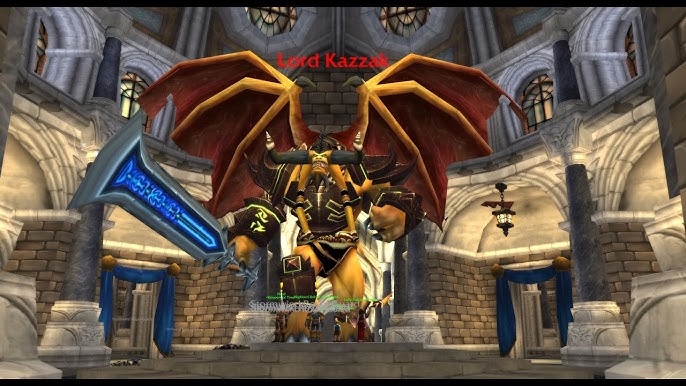
On Lord Kazzak, Captain Grim, and the Stories That Refuse to Close
There are certain explanations in World of Warcraft that arrive already completed. You don’t question them. You just recognize them.
“Hunters did it.”
It is offered casually. With confidence and certainty. And with just enough detail to feel like understanding. Lord Kazzak in Stormwind? Hunters kited him. Corrupted Blood spreading across Azeroth? Hunters and their pets carried it out of containment. The explanation lands and settles. Case closed. It makes sense. Or at least, it feels like it does.
Kiting is a known practice. Hunters pull, move, maintain distance, manage threat. It is a technique. A skill. A way of redistributing danger across space and time. Anyone who has played the game understands this at a basic level.
So when something goes wrong, when something escapes its intended boundaries, kiting becomes a ready-made answer. A mechanism we can point to. A player we can name.
“Hunters did it.”
But what, exactly, is being explained?
Because the events themselves resist that simplicity.
The Corrupted Blood incident was not just a matter of players moving debuffs. It involved pets, NPCs, zone transitions, and systems interacting in ways that exceeded their design. It spread because the world system allowed it, through features intended for other functions.
I wrote elsewhere about coming to World of Warcraft through that moment, through the recognition that something in-game had become meaningful enough to travel beyond it. That entry point matters here, because what I encountered was not a single cause, but a system behaving in ways no one fully controlled.
Lord Kazzak did not simply appear in Stormwind because a hunter pulled him there. His presence required a series of conditions: aggro rules, pathing, persistence, the permeability of boundaries between spaces that were not meant to touch.
In both cases, what occurred was not a single action or player intent, but a system behaving beyond expectation.
And yet, we say:
“Hunters did it.”
I love this explanation. Not because it is sufficient, but because it is so satisfying. It gives us a face. A class. A practice. It turns something distributed and difficult into something graspable. It lets us stop asking questions. It is, in that sense, a perfect example of common sense.
And then there is Captain Grim. He doesn’t reject the explanation. He doesn’t say, “Actually, the system behaved in complex, emergent ways that cannot be reduced to individual player action.”
He says: Yes. Hunters did it.
Of course they did. I mean look at them.
In Captain Grim’s telling, the hunter is not a convenient cause. The hunter is a figure. A presence. A kind of agent of chaos that moves through the world, pulling things where they are not meant to go, stretching encounters past their limits, delighting in the very instability that the system tries to contain.
The explanation is not refined. It is performed. And in that performance, something shifts. Now, “hunters did it” is no longer an answer. It’s a story.
I will admit that I have a personal affection for this framing. My main, Linnarra, is a Beast Mastery hunter. I am, at least in theory, part of this lineage of chaos. I would love to say that I, too, aspire to kite world bosses into capital cities and leave a trail of destruction in my wake. I do not. I am neither that brave nor that skilled a player. Besides, Lord Kazzak is leashed now. Still, the idea remains.
This is the difference that interests me: the same phrase can do two very different kinds of work. In one register, it closes meaning. It tells us we understand what happened. It stabilizes the event into a clean narrative with a clear cause. In another, it opens meaning. It invites retelling. It accumulates detail, exaggeration, humor. It becomes part of a shared memory that is not concerned with precision, but with resonance.

Captain Grim keeps the phrase, but refuses the closure.
I find myself returning to these moments, the ones that resist easy explanation. The ones where systems exceed themselves. The ones where players become part of something larger than intention. They remind me that what we often call understanding is, sometimes, just the point at which we decide to stop looking.
We say “hunters did it” as if that settles the matter. Captain Grim says it as if that’s where the story begins.
And maybe that is why we stay. Not because everything can be explained. But because, sometimes, it can’t. And still, it means something. Even when we can’t say exactly why.

Leave a Reply