
“Be kind, for everyone you meet is fighting a great battle.”
I have carried this line with me for years. It’s commonly attributed to Ian Maclaren, pen name for Rev. John Watson, a minister and author from the late 1800s. The statement is less a sentiment, more an orientation. It is a refusal to take what is visible as sufficient. What we see of one another is always partial. What we understand is even less. And yet, we move through the world as if perception grants us knowledge, as if what is legible is what is real.
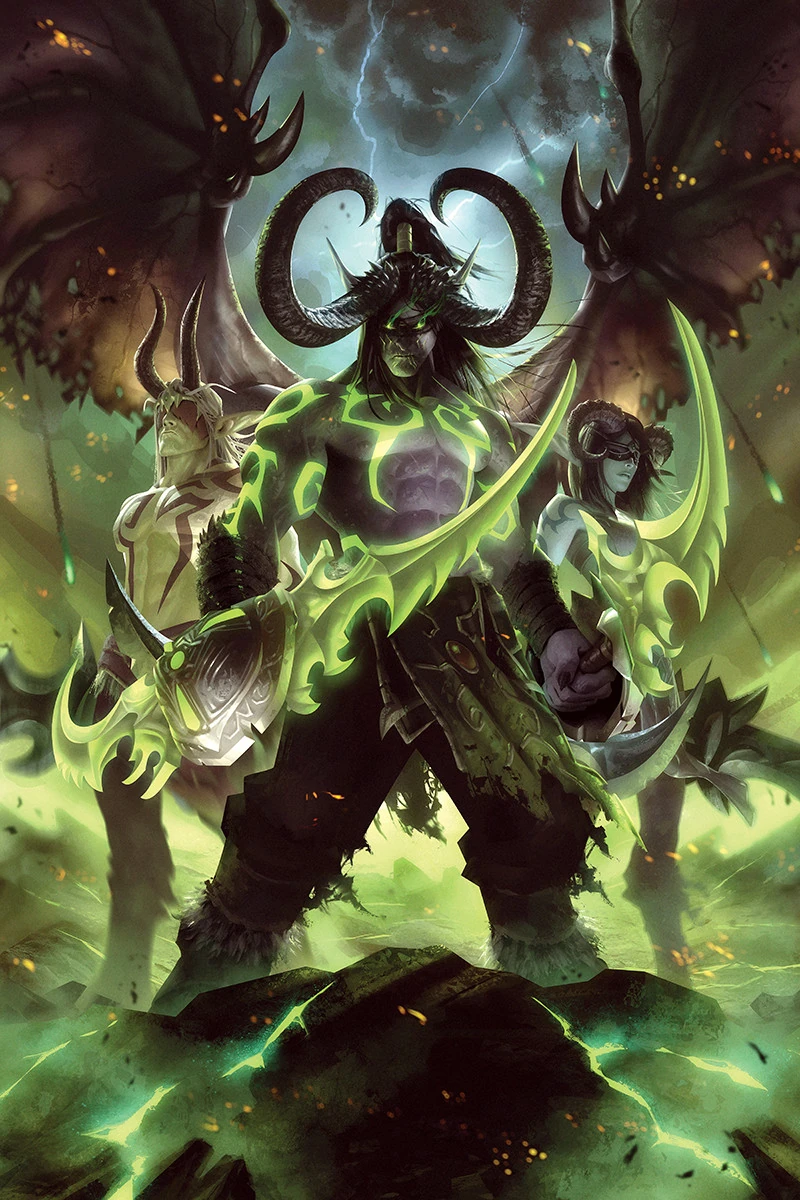
Demon Hunters make this limit visible.
The Illidari of the World of Warcraft universe are marked in ways that cannot be ignored. Blindfolded, tattooed, transformed. Their difference is on the surface, yes. And yet, what defines them cannot be seen. The constant negotiation with the demon within, the discipline required to hold that line, the cost of remaining themselves. These do not present. They are lived, not displayed.
Even here, where the signs are obvious, recognition remains partial.
Others see what they are capable of, not what they carry. They are feared, contained, instrumentalized. The terms of their existence are misread because they are reduced to what can be perceived. Sight, in this case, does not produce understanding. It produces certainty where none is warranted.
This is not unique to Demon Hunters.

We move through our lives surrounded by people whose interior conditions exceed what we can know. Not only because they choose not to disclose—as they should be free to do or not—but because much of what is carried cannot be easily articulated. Sometimes it is not even fully visible to the person themselves. The assumption that we can fully see, fully know, fully assess another person is not just incorrect. It is an ethical failure. Hubris.
Partial recognition is not a flaw to be corrected. It is a condition to be acknowledged. And acknowledging it requires something harder than empathy in the abstract. It requires resisting the urge to complete the picture. To hold the gap open rather than fill it with assumption. To stay in relation without claiming to have arrived at understanding.
What makes this difficult is that incompleteness feels uncomfortable. We are trained to resolve it. To read the signs available and move toward conclusion. But the signs are never the whole, and the conclusions we reach from them are always, to some degree, about us. What we can tolerate not knowing, what we need the other person to be.
There is something the Illidari understand that others around them often do not: that some of what is carried can only be seen from the inside. And even then, only partially. There are things that come into view only in reflection, in encounter, in the presence of someone who does not reduce what they see to what they can use. Not a judge. Not an assessor. A witness, willing to remain in the uncertainty of another person’s full complexity. That kind of witness is rare. It may be the most demanding form of care there is.
“Be kind,” then, is not a call to politeness. It is a recognition of limit. It is an acknowledgment that what we encounter in others is always less than what is there—and that the appropriate response to that gap is not to close it, but to hold it with care.
The battle is real, whether we see it or not.
Leave a Reply