
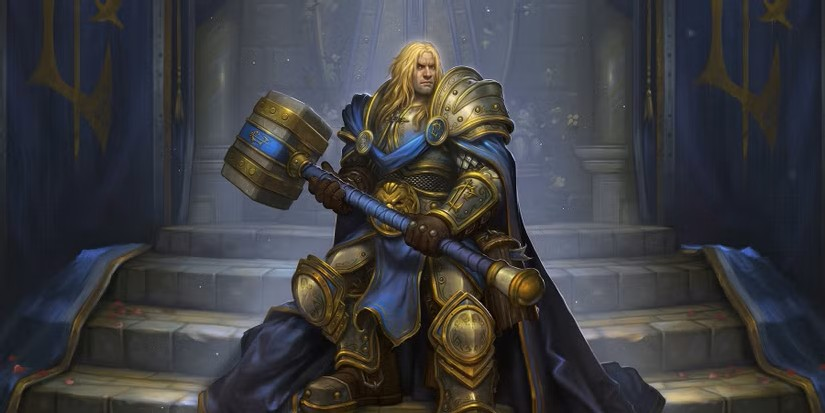
We often encounter the character Arthas Menethil as monstrosity, an irredeemable bad guy. The Lich King on the Frozen Throne. The man who killed his father. The prince who razed Stratholme with his own hand and called it mercy. That version offers us the comfort of clean moral distance. A villain whose choices can be surveyed from the outside, cataloged, and condemned without implicating us.
This is a very convenient version of Arthas Menethil. The more interesting one existed before the Culling of Stratholme. Long before.
The Arthas I want to talk about is the one who loved Lordaeron. Who wept over his people’s suffering. The one who rode out to stop a plague because the alternative — standing still while his kingdom died — was not something his love would permit. That love was real and true. It was not performed, not strategic or tactical, not the calculated positioning of someone who understood exactly what they were doing. It was the thing he was made of. And it became, in the end, the primary instrument of his undoing.
I will say this now, before I go on: the goal is not to not love. The goal is to love anyway, knowing.

What gets called an Arthas moment is not a single dramatic crossing. It is not the moment he picked up Frostmourne. Or rather, it is, but only because Frostmourne was preceded by Stratholme, and Stratholme was preceded by the choice to pursue Mal’Ganis north when Jaina begged him to stop, and that choice was preceded by a hundred smaller ones, each justifiable from inside the previous one, each feeling like the necessary extension of what came before.
This is what makes Arthas moments so difficult to identify and name in the moment they are happening. They don’t arrive with flags or flashing lights. They don’t feel like betrayals of the self. They feel like survival. They feel like the only available path forward given the constraints of the situation, the urgency of the need, the weight of what is at stake. They are always accompanied, in the moment, by a logic that is internally coherent. The sword will save my people. The purge is the only way to stop the spread. I have to go further because I have already come this far.
The self-evacuation happens in the accumulation. It is not Frostmourne alone. It is Stratholme first — the purge, where Uther refuses, Jaina walks away, and Arthas does it anyway. Then Northrend, the burned ships, Muradin left for dead at the glacier, and Frostmourne claimed. Then Uther struck down in Andorhal. Then his father, in the throne room of the kingdom he loved. Then the long walk up Icecrown. Each step is the logical extension of the last, until the destination is monstrous and the origin is so far away, unreachable. The Lich King still wears Arthas’s face. Still knows the names of everyone Arthas loved. But Arthas is no longer there.
This is not burnout. Burnout implies the self is still there, depleted, waiting for restoration. You can recover from burnout. You rest, you return, you find the self more or less where you left it.
Evacuation is different. Evacuation means what comes back to the waiting room is not the one who left. The performance of the self continues. The face remains. The name, the biography, the institutional function — they are all still present, still legible. But something essential has left incrementally through each contortion that went unnamed as what it actually was.

I cannot give you a list of my own Arthas moments. This is not evasion. It is the nature of the thing itself. I do know we all have them.
Arthas moments leave impressions, not edges. I have registered them — a sense of having bent in a direction that cost something, of having swallowed something that should have been said, of having stayed in a room or a role or a posture past the point where staying was honest — but I cannot reconstruct them with the clean specificity of a timeline. They dissolve into the texture of the life as it was being lived. That is how they work. That is precisely how they work.
What I know is that I was somewhere once, and by the time I remember to pause and look around, the distance between where I was and where I had started was larger than any single choice I could point to. The accumulation had happened while I was managing each day’s version of the necessary.
Kael’thas Sunstrider teaches us something similar and important: the wound can learn to drive. The injury can become the primary organizing fact, routing every subsequent choice through its logic, until protection and capitulation become indistinguishable. But Arthas teaches something harder. He was not primarily governed by a wound. He was governed by love. By the genuine, uncalculated desire to save what he loved. And love, without examination, without the willingness to ask what it is doing and what it is costing, can evacuate a person just as thoroughly as injury can.
Perhaps more thoroughly, because love feels like virtue. The wound at least announces itself as a wound. Love announces itself as purpose.

There is a figure in the Warcraft lore who understood this.
Jaina Proudmoore loved Arthas before any of the little compromises occurred. She knew the paladin, the one who wept, who cared, who would have done anything for the people and the land he loved. She was there at Stratholme. She begged him to stop. That wasn’t enough. She then spent the years of the Scourge’s reign living with the knowledge of what he had become, carrying the record of who he had been right beside it.
In Wrath of the Lich King, she still asks whether he is still in there, somewhere, somehow.
After Stratholme. After Lordaeron. After his father. After everything she witnessed and everything she was made to carry. She is still asks whether the paladin she knew still exists somewhere inside the Lich King’s apparatus.
That question is not denial or sentimentality. It is an act of witnessing.
Jaina holds the record of who Arthas was against the full evidence of what he became. She refuses — not naively, not with false hope, but with full knowledge of the cost — to let the Lich King be the only story. She keeps asking because the asking is an act of meaning. It says: there was someone here. I knew him. His leaving, his disappearance matters. The evacuation cannot, will not go unrecorded.
What I have come to understand is that the necessary practice is not to find an external Jaina. It is to cultivate an internal one.
The internal Jaina does not announce herself. She does not issue proclamations or arrive with alarms. She whispers. She is the quiet voice that already knows you, the one who holds the record of who you were before the accumulation began, before the first contortion that felt temporary, before the first Frostmourne you picked up because the alternative felt like abandonment. She asks, softly, in the middle of the next choice: is this still you? Is the paladin still here?
Tending to her voice is the practice. Regardless of faith tradition, many say God does not always come as a burning bush or the parting of the sea. He comes every day as a tender whisper. Many traditions have built entire architectures around learning to hear exactly this—the still small voice that arrives not in spectacle but in the quiet that follows it. The contemplative practices, the disciplines of interiority, the daily returning to silence—these are not incidental. They exist because the voice is real. It is quiet and it requires cultivation to hear.
Not because she can stop the Arthas moments from happening — they will happen, because you will keep loving things, and love without armor is always a potential entry point. But because the still small voice is the difference between an evacuation that goes unnamed and one that gets witnessed.

Love is not the problem.
I want to insist on this because the easy read of Arthas is that love is dangerous, that attachment produces vulnerability, that the solution is some form of strategic detachment — care less, hold less tightly, do not let the kingdom matter so much that you would pick up a cursed sword to save it.
That reading produces Kel’Thuzad. The institutionalist who assessed the apparatus clearly and chose it out of conviction, without the mess of genuine attachment. The one who will serve whoever sits on the Frozen Throne because his investment was never in the people, only the structure. But notice what else is absent: not just love, but idiosyncrasy. No specific hunger for the love to route through. No architecture that devotion could inhabit and distort. Which is why his corruption is stable where Arthas’s is catastrophic. Kel’Thuzad was never in danger of being consumed from the inside, because there was no inside that love had ever fully occupied. Detachment from love does not produce integrity. It produces a different kind of hollowness, one that was never inhabited to begin with. Only one of them started full. Only one of them could be destroyed by what they carried.
The goal is to love anyway, knowing. Knowing that the love is a vulnerability, but not only because it leaves you exposed. Because love routes through you. Through your specific hunger — for resolution, for not-failing, for being the one who saved what you loved. The idiosyncrasy is the engine. The love is the fuel. And the engine determines where the fuel goes. This is why Arthas’s undoing was not just love, but love filtered through pride, through the specific inability to accept that his will applied at full force might still be insufficient. The love was real. The engine was also real. Together they produced Frostmourne. Knowing, then, means knowing yourself. Not just that you love, but which version of you is currently driving. The internal Jaina does not only ask: is the paladin still there? She also asks the harder question: is this the one who loves the thing, or the one who cannot stand to lose, wearing the face of the one who loves? The asking requires self-knowledge, not just open eyes. To keep choosing love while knowing your own architecture. That is the practice. We are the weapons we make of love. The shape of the weapon is ours.
Knowing that our love can be weaponized by the institutions that need our devotion to function. This is why kapwa, at its most demanding, is not softness. It is not the love that evacuates the self in service of the other. Not the love that holds the self so tightly nothing can touch it. Kapwa is the love that holds the self and the other simultaneously, that witnesses both without dissolving either, that can say I love this kingdom and also I will not pick up Frostmourne. You don’t pick up Frostmourne because picking it up will make the Lich King, and the Lich King cannot love Lordaeron. He can only use it.

In Shadowlands, the eighth expansion, by the time the players reach him, what is left of Arthas is almost nothing. The husk in the Maw. The soul that experienced everything the Lich King did, carried the full weight of the culmination of deeds, with no armor and no apparatus and no Helm of Domination to distribute the cost. Just whatever survived the whole, entire ordeal.
The Shadowlands husk is the endpoint of the accumulation. What is left when the face has finally stopped performing, and there is nothing behind it but the record of what it cost.
And yet.
He was there. Something remained. The waiting room was nearly empty. But nearly is not the same as entirely. Which means the paladin persisted, somehow, through everything. He was not intact. Not functional. But present, in whatever attenuated form a soul can maintain through the full weight of becoming the Lich King and then being stripped of even that.
The practice of the internal Jaina is not a guarantee against Arthas moments. It is not a system that prevents evacuation. It is the commitment to keep asking the question — is the paladin still there? — even when the answer is frightening. Even when the answer is: barely. Even when the answer is: I have to look harder than I expected to find her.
The asking is the act of meaning. Not the rescue. Not the triumphant return to wholeness. Just the refusal to let the evacuation go unwitnessed. The insistence that there was someone here who loved something, and that this matters, even — especially — when the love became the instrument of its own undoing.
I have had Arthas moments. I know this the way I know weather. Not by the specific moment the temperature changed, but by where I found myself when I looked up. The accumulation happened. It always does, for anyone who loves something enough to be moved by it.
What I know how to do now, imperfectly and with a great deal of effort, is tend to the voice that keeps asking. She does not announce herself. She does not wait for a convenient moment or a clean stage. She asks in the middle of the next contortion, in the small hours, in the pause before the choice gets made.
She already knows me. She has always known me. She is holding the record.
I am still here, present enough to hear her. That is not nothing.
That is, in fact, everything.
Leave a Reply