
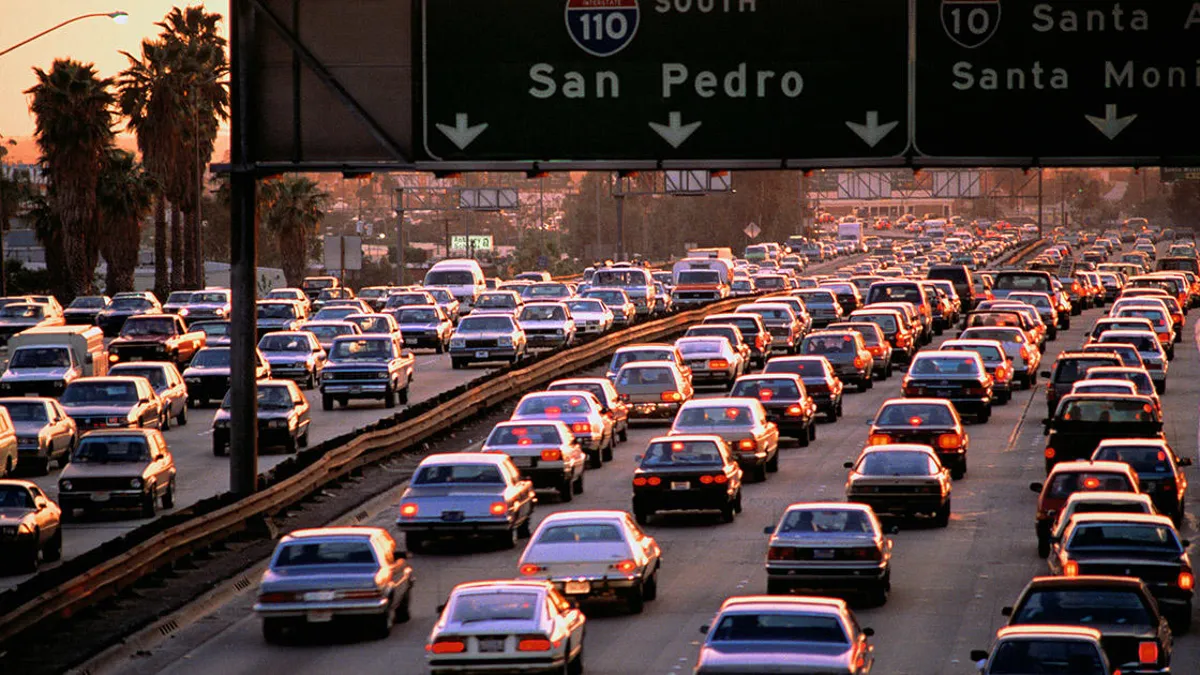
Near the end of No Other Choice, Man-su sits in his car on the expressway. The traffic has stopped. Around him are enormous trucks carrying lumber destined for the paper mill. The trucks tower over his small car. He cannot move. The vehicles box him in on every side.
At first, the image reads as personal entrapment. Man-su has survived the film’s brutal ordeal—unemployment, humiliation, desperation—but the final frame suggests that survival has not brought freedom. He has found a place in the system, but the system still surrounds him.
Then the camera pulls back.
What initially looks like Man-su’s private predicament reveals itself as something much larger. The entire expressway is frozen. Cars stretch into the distance. Trucks carrying logs fill the lanes. Everyone is stuck. The zoom-out transforms the meaning of the scene. The problem is not Man-su’s alone. The trap is systemic.
Earlier in the story, Man-su experiences unemployment as a personal crisis. He must compete harder, endure more humiliation, push himself further to secure a new job. The logic of the labor market encourages this interpretation. Failure appears individual. Success appears individual. Survival becomes a matter of personal endurance. The positive affirmations and tapping rituals all highlight the individual nature of his predicament.
I am a good person.
Losing my job is not my choice.
In three months, I will be hired again.
But the final image quietly undermines this logic. If the entire highway is immobilized, then no one is actually moving forward. The system continues to run, but its participants remain locked in place.

The trucks surrounding Man-su carry lumber meant for the paper mill where he now works. Trees become pulp, pulp becomes paper, and paper becomes the infrastructure of bureaucratic life: forms, records, contracts, reports. The modern economy runs on documentation.
Yet the story of how Man-su survived will never appear on any of those pages. The system produces endless paper while erasing the human violence and desperation that sustain it. The trucks move materials efficiently through the supply chain, but the human beings inside the system remain stalled in traffic.
This contrast becomes even sharper when we consider Man-su’s new job. By the end of the film, he supervises robots in the paper factory. Machines carry out the work with perfect obedience. They do not protest. They do not refuse. They do not remember anything.
Man-su, however, remembers everything. He remembers the humiliations that drove him toward desperation. He remembers the compromises he made. He remembers the violence that allowed him to secure his place again inside the economy.
Standing among the robots, he is the only entity on the factory floor who carries memory. That memory does not grant him freedom. It simply marks the distance between the human condition and the machinery that now governs his life.
The expressway scene makes this tension visible. The system continues to move materials—trees toward the mill, paper toward the world—but the people within it remain confined to its logic. What appears at first to be Man-su’s personal trap turns out to be something closer to a structural condition.
There is no outside.
The highway stretches endlessly in both directions. The trucks continue delivering wood. The mill continues producing paper. The system continues to run. And the people inside it sit in their cars, waiting for movement that never quite arrives.
Man-su’s story ends not with escape but with recognition. He survived. But survival did not lead him out of the machine. It only revealed how completely he, and everyone else, already lives inside it.
Leave a Reply