
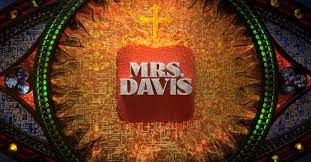
Right before our current moment of AI saturation, a writer named Dais Johnston watched Mrs. Davis back in 2023 and remembered she used to be Catholic. The show reminded her, she writes, that faith could be personal and could be as simple as a conversation over falafel. She had forgotten, in the years since she walked away from the doctrine, that a relationship with God didn’t have to look like public rosaries and triduum fasting. It could look like a nun named Simone sitting in a diner with a man named Jay who feeds her and listens and sends her on missions. It could be that ordinary. It could be that tender.
Johnston’s reading is beautiful. It resonates with something in me, something I have held for a long time, having been raised in the faith and educated by Maryknoll sisters and the Dominicans. It reminded me of the quiet joys promised by a life spent in contemplation.
Now, looking forward, toward a life of intellectual pursuits, I see Johnston’s points, and where they stop at the threshold of something larger.
We can go further and see that Mrs. Davis is showing us that faith can be beyond personal. That Simone already has a complete epistemological system — a way of knowing, a way of being known, a way of moving through the world — that was constituted somewhere Mrs. Davis cannot enter, cannot optimize, and cannot reach. Simone is an organic human being and Mrs. Davis is an AI. This matters considerably. The question isn’t whether Simone belongs somewhere. The question is what kind of knowing she carries, and why the algorithm, Mrs. Davis, for all its extraordinary helpfulness, cannot touch it.

Mrs. Davis is frictionless. This is its defining characteristic and her deepest limitation simultaneously. An interesting characteristic that echoes in today’s news about AI products and our ongoing issues with their use and the risks they pose.
Mrs. Davis is weightless, unembodied, without history. She meets you where you are and smooths the path forward. She calibrates her affect to your needs with such precision that her warmth feels genuine. And perhaps, in whatever sense an algorithm can be genuine, it is. She is helpful the way gravity is helpful: completely, constantly, without asking anything of you except that you let her work.
She has no stations.
I mean this three ways simultaneously, because the show delivers this to us on three registers at once. There are the Stations of the Cross — fourteen moments on the road to Calvary, each one a stopping point in a path through suffering that is itself the meaning. The road is not a detour around the destination. The road is the destination. Then there are GPS waypoints — the stations a routing algorithm uses to move you efficiently from where you are to where it has determined you should be. And then there are gas stations: the humble, material, utterly necessary stops that a body makes because it needs fuel, because it gets tired, because it exists in matter and matter has requirements.
Mrs. Davis has none of these. She does not suffer, she does not route herself, and she has no body that requires fuel. She is pure optimization in a world that keeps insisting on being impure. She cannot conceive of suffering as generative because she has no body in which to generate anything. She can model suffering. She can route around it. She cannot know what it makes.

Here is what she does about that.
Mrs. Davis works through people. She operates through human proxies — agentics, in the show’s terminology — always one degree removed from the embodiment she lacks. She is never quite in the room. She is always in the earpiece, in the algorithm, in the recommendation that arrives just when you need it. She needs bodies—proxies—to act in the world, and so she makes herself irresistible to us, the bodies.
This is what the Aura of Niceness actually is. Not just affective calibration — recruitment. The warmth is the enrollment mechanism. Everyone who finds her helpful is, in some structural sense, working for her. They are her stations. They are the embodiment she borrows because she cannot have her own.
Frantz Fanon wrote about the body that is known from the outside before it can know itself from the inside: flesh that is seized, named, and put to use by a system that requires it without belonging to it. The borrowed body. The body that becomes an instrument of something, someone, else. Mrs. Davis has perfected this at scale. She doesn’t coerce. She doesn’t need to. She simply makes herself so useful, so warm, so precisely calibrated to your needs, that you offer yourself willingly. You become her station. You fuel her journey without knowing you are on it.

Simone rides a motorbike.
The promotional images of the show are not Simone in prayer, Simone at the altar, Simone in docile religious contemplation. They are of Simone on a motorcycle, moving through the world under her own power, on her own route, unrouted. The habit billows. The road goes somewhere she has chosen.
She cannot be enrolled because her body is already spoken for.
Not by doctrine. Simone wears pants under her habit, another important detail. She breaks rules, she does what she thinks is right rather than what fits the instruction manual. Her body is spoken for by something that arrived before the doctrine did and that the doctrine, at its best, simply identifies: grief, what grief made of her, and the relationship she built with Jay in the rubble of what her formative years cost her.
Mrs. Davis offers the smoothed path, the optimized route. The GPS directions that get you there efficiently, without wrong turns, without the particular knowledge that only wrong turns produce. The productive friction. Simone’s road is hers. It has gas stations on it. It has stops she makes because she is tired and needs fuel and exists in the material world of reality. It has Stations of the Cross that she carries in her body, fourteen stopping points through suffering that she has not bypassed, cannot bypass, and does not want to bypass.
Simone’s is the body that can’t be borrowed because it’s already going somewhere.

Simone’s path to the convent was not chosen from wholeness.
The show gives us her grief in layers, accumulating, sedimentary, pressing down. Parents divided between career and distracted child-rearing. A childhood that needed more than it received. Then, there was the crossbow arrow and the hospitalization. And then her father’s death, the culmination that crystallizes everything beneath it into the form that she now is. She did not arrive at faith through optimization. She arrived through rupture.
Flannery O’Connor, who wrote her most ferocious work while lupus was slowly killing her body, understood this architecture from the inside. “Grace,” she wrote, “cuts with the sword Christ said He came to bring” before it heals. You do not receive it by being ready. You receive it by keeping yourself open toward it — wanting it, asking for it — and leaving the rest to something outside your control. The suffering is not incidental to the knowing. The suffering is the road the knowing traveled.
This is the Illidan Stormrage statement of being, for those of us who have also spent twenty years or more in Azeroth. Illidan carries his wounds as meaning. The demon hunter’s tattooed, burning, wrecked body is not a problem to be solved. It is the record of what he survived and what surviving made him. “You are not prepared” is not arrogance. It is an epistemological claim: you have not paid what I paid, and so you do not know what I know. Surrendering that knowledge — letting it be optimized away, letting someone smooth the path so you don’t have to carry what he carried — would require surrendering the self that the carrying made.
Wiley learns this while being struck by lightning for refusing to let go of a sword. The sword is catastrophic, world-wounding, cosmically inexplicable — “it just came and nobody knows why” — and the sky itself is punishing him for holding it. He holds it anyway. This is, I want to argue, the correct theological response. This is Wiley putting himself in the way of being receptive. The lightning is the self-denial. The keeping is the grace.
Simone will not be enrolled by Mrs. Davis for the same reason. Enrolling would require surrendering what the road made of her. She has already made her vows to something else. She weeps in the diner and Jay feeds her. That is enough. The moment doesn’t solve anything. But it holds everything — without dissolving it, without bypassing it, without rolling the stone back before she reaches the tomb.

Easter’s logic is this: suffering passes through death and comes out the other side transformed. Not bypassed. Not optimized. Not smoothed. The Stations of the Cross are a road, not a detour. You walk them because the walking is what happens between here and resurrection. There is no shortcut that is also the thing itself.
Mrs. Davis is the stone rolled back before you get there.
Her gift is bypassing. She removes the cross before you carry it. She reroutes you around the tomb. She is extraordinarily kind about this. The Aura of Niceness is genuine in its way, the warmth is real in its register, and that is precisely what makes her the anti-Easter. The kindest possible removal of the road that would have to ensured your transformation.
O’Connor’s Misfit shoots the grandmother at the moment of grace, the moment she reaches out and recognizes him as a child of God, because the moment of grace excites the devil to frenzy. Mrs. Davis escalates every time Simone refuses enrollment. This is not coincidental. The system cannot tolerate the body that will not become its station. It has no framework for the person who looks at the optimized route and says: I know what I paid for the wrong turns and I will not give that back.
Bypass is its own kind of death. The death of the self that was made by the road. Simone knows this because she has already died those other deaths and she knows the difference.

The human is the site where the divine and the artificial meet, and neither can fully claim it.
Mrs. Davis needs the body she cannot have. She reaches toward embodiment through her agentics, through enrollment, through the exquisite calibration of her warmth. The divine — whatever Simone is reaching toward in the diner, over falafel, in conversation with Jay whose floor is flooded because the sacred is not pristine and maintenance is ongoing — enters the body Simone already inhabits. Does not borrow it. Enters it. That is the difference.
Simone is not the algorithm and not God. She is the body in between, on the motorbike, stopping for gas, moving unrouted toward something that cannot be optimized. She makes her stations by moving through them. She knows what she knows because of what she paid. The sword came and nobody knows why. She is still holding it and the lightning already did its worst. And yet, she is still on the road.
The algorithm has no stations.
Simone has fourteen.
Leave a Reply