
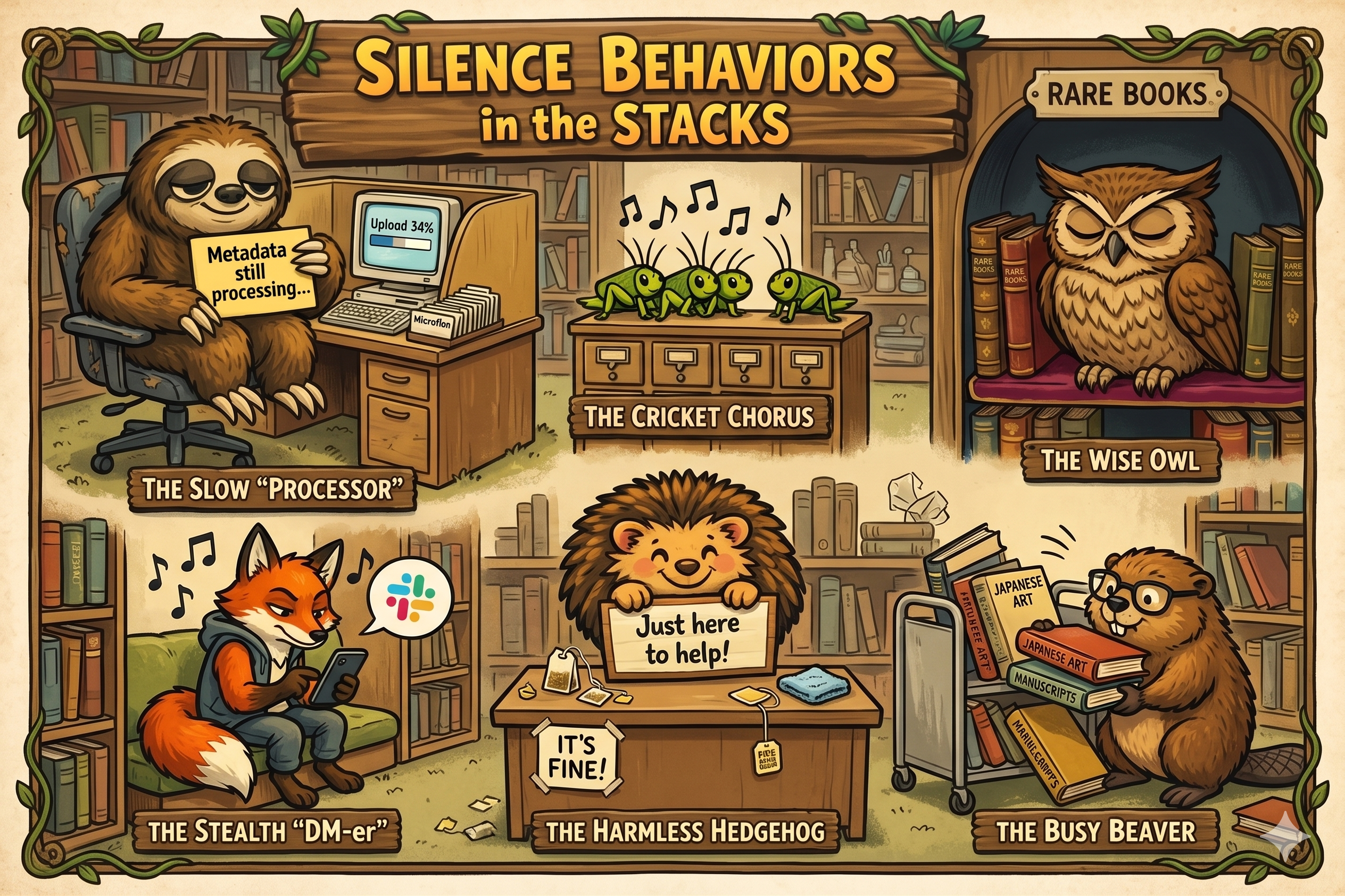
Welcome, fellow academic library explorers! Have you ever noticed that a university library isn’t just a quiet place for study? It’s a dense, thriving ecosystem of institutional logic and relational labor! And like any wild habitat, it has its distinct, and often amusingly predictable, inhabitants. Today, we’re going to help you identify and manage the most dangerous of these “Silent Types” found within the stacks.
Based on our intensive field studies (conducted between reference shifts and dissertation brainstorming while sipping free coffee), we’ve documented the top seven Silence Behaviors you’re bound to encounter.
The Official Field Guide to Silence Behaviors
Check your charts, folks, because if you’ve spent any time in a faculty meeting or at the circulation desk, you’ve definitely seen these characters.
1. The Slow “Processor”
Habitat: The Metadata & Catalog Den
We’ve all met the Sloth. This creature is often found near a terminal, where its primary function seems to be displaying a perpetually spinning “34% Uploading…” icon.
- Key Behavioral Pattern: A tendency to stare at a screen for unnerving lengths of time while a massive system migration or record update crawls along.
- Signature Phrase: “Metadata still processing…”
- How to Handle: Do not, under any circumstances, ask for a timeline update before the progress bar moves. Just… wait. Bring a snack. Maybe a copy of Homo Academicus to pass the time.
2. The Stealth DM-er
Habitat: The Staff Lounge / The Slack Back-Channel
The elusive Fox is a master of non-verbal, non-audible communication. It never speaks up during the departmental meeting about library faculty governance, but its Slack game is ferocious. It thrives on back-channel agreements and establishing a private consensus.
- Key Behavioral Pattern: Subtle “pop” notifications echoing from their pocket while they maintain a perfectly neutral expression during a heated debate.
- Signature Phrase: [Sends a DM: “I totally agree with you… but just between us, okay?”]
- How to Handle: Acknowledge the notification. If you want them to go “on the record,” try saying, “I just got a great point via chat—could you share that institutional critique with the whole group?” Watch the Fox vanish.

3. The Topic Changer
Habitat: The Collection Development Committee
The elegant Goose is the undisputed champion of the tactical pivot. It never answers a difficult question about budget cuts because it’s already flying south to a completely different subject. It can turn a project crisis into a discussion about “new database subscriptions” in under five seconds.
- Key Behavioral Pattern: Introducing non-sequiturs that sound suspiciously like genuine scholarly inquiries.
- Signature Phrase: “Hey, how about those new database subscriptions?”
- How to Handle: Acknowledge the pivot with a simple, “Good point for later!” Then, immediately fly back to the original topic before the entire committee gets lost in the weeds.
4. The Wise Owl
Habitat: The Rare Books & Special Collections Nook
The Wise Owl is an ancient and revered creature of institutional memory. It has seen the dawn of countless strategic plans, and it knows exactly which ones will fail. Its silence is not emptiness; it’s a terrifying accumulation of academic wisdom. When it looks at your new project proposal and just blinks, it’s because it sees the inevitable logistical nightmare on page 14.
- Key Behavioral Pattern: A piercing, judgment-filled gaze followed by a long, unblinking pause.
- Signature Phrase: “…silent…”
- How to Handle: Offer the Owl coffee. Ask for its perspective directly. Be prepared for a very, very long silence before it gives you the absolute, historically-grounded correct answer.
5. The Harmless Hedgehog
Habitat: The Desk Garden / Outreach Office
The Hedgehog is a creature of pure, well-intentioned joy. It wants to help! It just… doesn’t know how to fix the broken proxy server. Its strategy for handling institutional conflict is to just continue being incredibly adorable and optimistic.
- Key Behavioral Pattern: Holding up signs of encouragement like “Just here to help!” even as the library’s main website goes down.
- Signature Phrase: “It’ll be fine! Just here to help!”
- How to Handle: Accept the cheer. Do not try to give the Hedgehog complex document analysis tasks. Just let it be the heart of the team and lift morale with chamomile tea.
6. The Busy Beaver
Habitat: The Stacks / Technical Services
The Beaver is a marvel of productivity, but it has zero time for your idle chit-chat. Its silence is purely utilitarian: talking wastes chewing time. It’s always building a new Japanese Art display or carrying a stack of manuscripts so large it acts as a physical barrier to conversation.
- Key Behavioral Pattern: Moving at 3x speed and effectively using a cart full of ILL materials to block any unwanted “quick questions.”
- Signature Phrase: “Sorry! Gotta run! So swamped!”
- How to Handle: Get out of the way! Do not ask the Beaver for anything during a mid-semester rush. Its stack of cataloging backlogs will crush you.
7. The Cricket Chorus
Habitat: The Institutional Void / The Search Committee Room
If you’ve ever pitched a radical new idea for the ACRL IL Framework or suggested a change to the status quo during a department-wide meeting, you’ve met the Crickets. These creatures represent the omnipresent ambient sound floor of the academic library.
- Key Behavioral Pattern: A rhythmic, collective chirping that fills the uncomfortable space where an answer, a volunteer, or a critique should be. They don’t speak, but they ensure the silence is never truly empty.
- Signature Phrase: [Cheerful, rhythmic chirping in 4/4 time]
- How to Handle: Don’t let the music lull you into a trance! The Chorus thrives on the Bystander Effect. To break the spell, call on a specific inhabitant of the jungle (perhaps the Wise Owl) to turn that ambient chirping into an actual conversation. Otherwise, you’ll just be left standing there while the crickets play you off the stage.

So you’ve got these Silent Types in your meeting. What’s the worst that can happen? Well, my friends, you could end up with The Echo Parrot.
This is the chaotic, colorful nightmare that appears when a meeting concludes without a clear, definitive action. The Echo Parrot mimics every piece of evasion and silence it hears, amplifying it into a beautiful, confusing jungle symphony.
Its main speech bubble is a glorious disaster of mixed messages:
“I need more time to think! Just between us, are the new databases fine? Wait, where are you going? So swamped!…Silent…It’ll be fine! Just here to help! So swamped!”
It’s the absolute perfect record of a meeting where everything was echoed, but nothing was decided.

The Survival Guide: How to Get to “Behold!”
So how do you tame your work jungle? Follow these simple rules, as modeled by our intrepid human colleague, Kevin, the Human Anomaly, who is currently staring at a calendar that says “Maybe, Just Perhaps”:
- Direct Communication: Don’t be afraid of the Wise Owl. A simple “Isn’t this an epistemic issue?” can break the silence and get to the real problem.
- Explicit Questions: Don’t let the “Topic Changer Goose” lead you on a wild chase. Say, “Great question! But first, can we get back to the dissertation deadline?”
- Actionable Items: Don’t let the “Hedgehog” just hold the sign. Give it a simple, clear task. And for the love of the library, give the “Sloth” more server bandwidth!
Next time you’re in the stacks and it starts getting quiet, look around. Is that the Sloth loading? The Beaver escaping? The Fox whispering? Be bold! Break the silence before your entire department turns into a beautiful, meaningless jungle soundscape.
Remember: A jungle of silence is just one Echo Parrot away from total chaos.
Good luck out there, team. Happy exploring!


Leave a Reply