
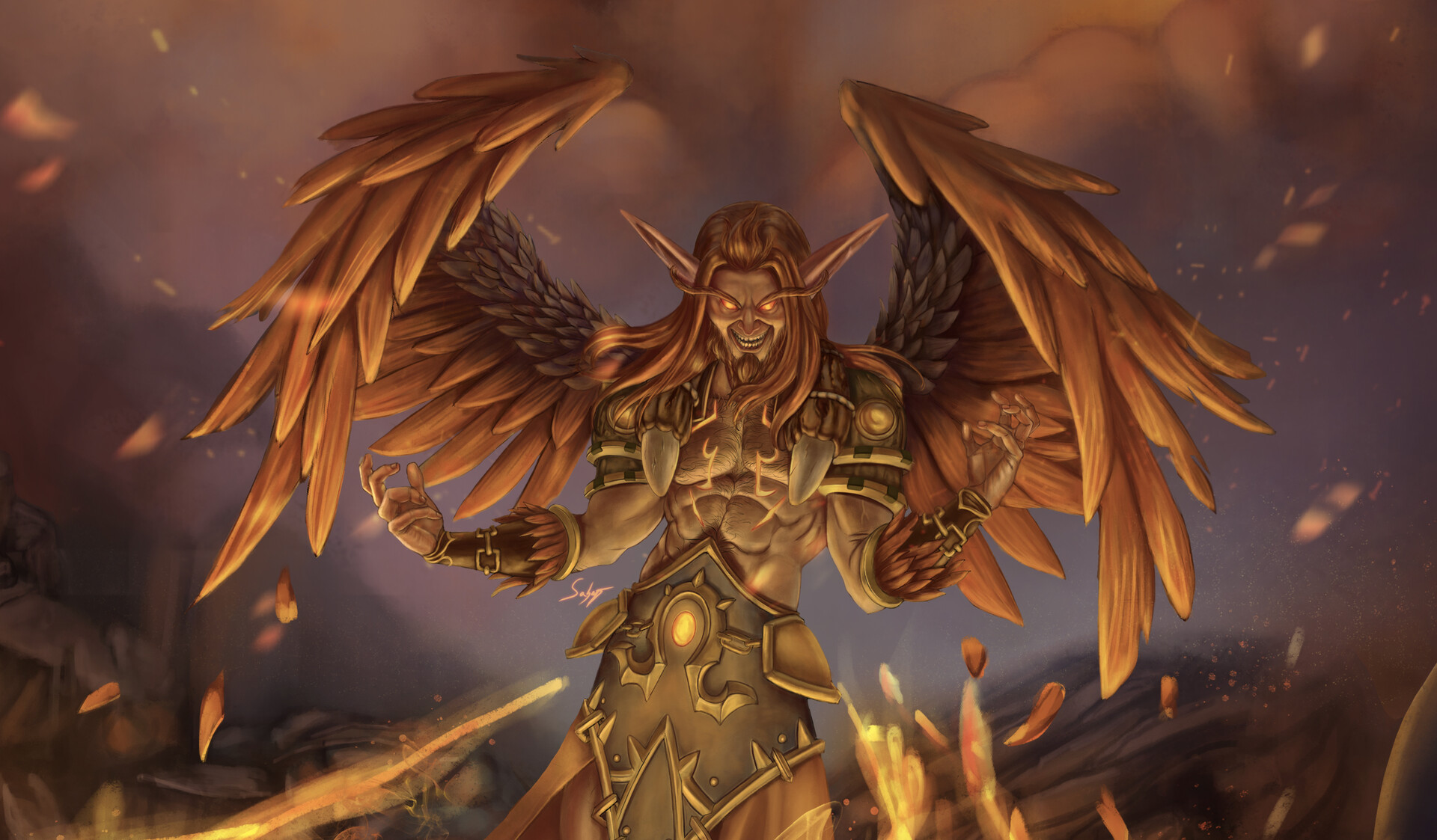
In the Cenarion Enclave in Darnassus, there is a quest chain that most players have completed without thinking twice about it. The Arch Druid, imperious, shirtless, radiating barely concealed contempt for your presence, had a research program. Morrowgrain. A mysterious herb. Grow it from Tharlendris seeds in Un’Goro soil, bring him ten, receive a goody bag, repeat. The quest was repeatable. The institution’s need for Morrowgrain was described as continuous. You ran it because the Cenarion Enclave was there, the Arch Druid was there, the quest marker was there, and the reward was decent. You did not ask what the research was for. The office of the Arch Druid framed it as legitimate, and that framing was sufficient.
What most players did not do (what the game never required them to do) was follow a different chain entirely. It started not in Darnassus, but in Feathermoon Stronghold, in Feralas, in the office of a druid named Quintis Jonespyre whose specialty was curses. Quintis was not comfortable. He had heard about the Arch Druid’s Morrowgrain procurement program, the institutional resources being deployed in the Cenarion Circle’s name, the quantities accumulating, and something about it made him feel, as he put it, weird. He wanted to understand it. He asked for your help.

Nobody had to take that quest. It was optional. Feathermoon Stronghold was out of the way. Quintis offered no particular prestige, no faction standing with the Cenarion Circle, no goody bag worth interrupting your leveling path to acquire. His reward was modest. His question was not.
What in the name of Elune is Staghelm up to with these things?
That question did not get answered in the game. The full answer arrived years later, in the novel Stormrage, and then in Cataclysm, when the Firelands opened and players finally understood what they had been growing all along. The Morrowgrain was a poison. Fandral Staghelm had been using it to keep Malfurion Stormrage — the rightful Archdruid, the legitimate steward of Night Elf druidic tradition — trapped in the Emerald Nightmare. The institution’s official research program was the mechanism of the vacancy it claimed to be filling. The goody bag was the compensation for doing that work without the player knowing it.

The discomfort was not even confined to Feralas. Mathrengyl Bearwalker — the druid stationed in the Cenarion Enclave who actually accepted the turn-ins, who stood inside the institution’s most central location and processed every stack — said it plainly, in the completion dialogue, every single time: “I must admit though… just being near them makes me feel a little uncomfortable. I can only imagine how difficult it is for the Arch Druid to tolerate them in such large numbers.” The unease was present at the point of transaction. It was present in Darnassus. It was in the main story. Players read it as flavor text and moved on.
And then there is this: the reputation reward for turning in Morrowgrain didn’t go to the Cenarion Circle, the organization whose name and resources framed the entire research program, but to Darnassus. The city, not the institution. The quest spoke the Cenarion Circle’s authority while building standing somewhere else entirely. The institutional cover and the institutional benefit did not even point in the same direction. Nobody noticed. The goody bag was enough.

The warning existed. The counter-narrative existed. In parallel. The whole time.
Most players never took that quest chain, or took both without registering what Quintis was actually saying, because Fandral’s institutional authority made the Darnassus version feel like the main story. Quintis felt like a side quest. Peripheral. Optional. His discomfort did not come with a quest marker pointing toward consequence. It came with a modest reward and an unanswered question, tucked into an outpost most players flew past on their way somewhere else.
This is worth sitting with. Not because it makes players culpable — you cannot be held responsible for not pursuing a quest the game did not require you to pursue. But because the structure of the optional chain is itself the argument. The game built the dissent in. It gave the counter-narrative a location, a speaker, a reward, a name. And then it made that chain optional, placed it out of the way, and let institutional authority do the rest. The main story swallowed the side quest not through suppression but through gravity. The Cenarion Enclave was simply more central. Darnassus was simply more convenient. The Arch Druid’s authority was simply more legible as the place where the actual story was happening.
Quintis didn’t need to be silenced. He just needed to be optional.

Fandral Staghelm did not begin as a villain. He began as a father.
His son Valstann died at Nighthaven during the War of the Shifting Sands. Valstann died in a way that Fandral correctly understood as preventable. He had asked Anachronos and the bronze dragonflight for more time. The answer was no. Valstann was killed in the gap between the appeal and the answer. Fandral carried that wound forward, into his ascension to Arch Druid, into his governance of the Cenarion Circle, into every interaction players had with him in Darnassus. The contempt, the imperious refusal, the barely concealed fury at being asked to justify himself to anyone.
The grief was true. The wound was genuine. This is not in dispute.
What the wound became is the question.
Grief, in institutional life, often operates as a kind of credential. Not always, not everywhere. Not in ways that are ever formally articulated. But it is recognizable, consistent in the ways of how institutions extend latitude. A figure who has suffered enormously is granted a particular exemption from the usual accounting. His difficulty gets read as understandable. His contempt gets read as a symptom of his loss. His governance decisions get evaluated inside a frame of moral credit that his suffering earned and his conduct slowly spends. The institution does not consciously choose to extend this exemption. It extends it the way fields extend anything: through the accumulated weight of how everyone around him decides, individually and without coordination, what to require of him.
Nobody sat down and decided that Fandral’s grief exempted him from scrutiny. Nobody passed a resolution. The exemption happened in the aggregate of many small decisions not to push, not to press, not to take the optional chain.
The grief credential is not a conspiracy. It’s a habit. And habits, in institutions, become structure.
Fandral Staghelm knew his grief was a credential. This is the part the lore does not state but cannot help but imply. A figure of his intelligence, operating inside an institution he had navigated all the way to its apex, understood what his suffering purchased. He did not manufacture the grief. The grief was catastrophic and genuine. He understood and saw its institutional function.He saw it and did not refuse it. He let the exemption accumulate. He let the credit build. He let everyone around him decide that the loss of Valstann explained him. He let that explanation be sufficient. The optional chain of what is he actually doing with those things was someone else’s work to undertake.
He turned in Morrowgrain. The institution handed him the goody bag. This happened for years.

In institutional life in the academy, there is generally a document that gets collectively written that points to a pattern, cited the bylaws, asked the right questions, and moved through proper channels. It is an instrument developed by faculty. It can also be thought of as the Quintis quest chain: careful, specific, located, available. It existed in parallel to an institutional performance of authority that had, for years, framed itself as the main story. The legitimate research program, the official Cenarion Enclave version, the place where the actual work of the institution was happening.
The document is received, yet often treated as having a tone problem. That’s how it gets filed as a side quest. One among many.
The figure at the center of the institutional performance had a grief credential of her own. Not the same as Fandral’s. It’s important to remember that nothing ever really maps perfectly. But a grief credential is very much like Fandral’s history of loss and labor that the institution had learned to hold gently, to read charitably, to exempt from the scrutiny it would extend to someone without that history. The document that named the pattern required treating her conduct the same way as it would treat anyone else’s. It required asking: regardless of what she has carried, what is she doing with these things?
The institution found that question optional.
This is not a conspiracy. It is a habit. The habit is the structure. The structure is the argument.

The Morrowgrain was a poison. The Arch Druid had been dispensing it through the institution’s official channels, sustained by resources the institution provided, under the name of research the institution endorsed. Malfurion Stormrage did not escape through an investigation. He escaped through a crisis, through events so catastrophic that the institution’s gravity finally bent toward the counter-narrative. Not because the counter-narrative had grown louder, but because the main story had become impossible to maintain.
Quintis never got an answer. He asked his question, in Feralas, with a modest reward and a genuine unease, and the institution moved on without him. The answer came from outside the optional chain entirely, from the novel, from the expansion, from the scale of consequence that made the lore finally comprehensible.
I don’t think we get to wait for the expansion.
The optional chain is not optional because the information is unavailable. It is optional because the institution has arranged itself around the preference not to take it. Quintis is in Feralas. He is still there. His question is still modest and his reward is still small. The Cenarion Enclave is still more convenient and the goody bag is still being distributed. The Arch Druid is still shirtless and imperious and radiating contempt for anyone who would ask him to account for what he is growing.
You don’t have to go to Feathermoon.
Most people don’t.
Leave a Reply